Tarot card features
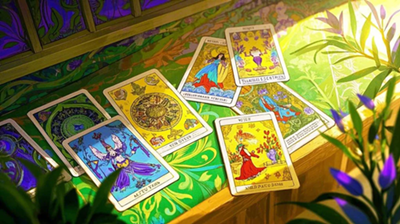
Tarot cards are composed of 22 tarot cards Major Arcana and 56 tarot number cards Minor Arcana, totaling 78 cards. Each exquisite card has its own unique pattern and meaning.
The method of tarot divination is to arrange and unfold the cards in a certain form, and then check the position of the cards to determine positive and negative energy. We can do divination for different needs such as love, health, wealth, marriage, etc. Especially when we don't know what action to take, it is a very good guiding tool to guide the future direction based on the past and current situation.
The Seven Origins of Tarot Cards
The preserved ancient and complete tarot cards first appeared in the 14th century.
But among the numerous origin theories of tarot cards, the following seven origin theories are the most famous and have corresponding basis, and there are also many supporters, including :
Italian doctrine
The basis is that tarot cards are related to a poker game called tarocco; The earliest available documents about tarot cards date from around the 14th century.
It is generally believed that the origin of tarot cards can be traced back to the 14th century Italian card game "tarocchi". "tarocchi" is used in a card game called "tarok", which means "ace" or "victory". And this game is still preserved in other
places (e.g. Italy), and this card game was very common among the Italian royal family. Sometimes the king even commissioned artists to draw quite exquisite cards, this is how some of the early cards were preserved. When tarot cards were introduced from Italy to the south of France, they were adapted to the different cultures of France.
There have also been some changes to 'tarocchi' and the name has been changed to 'tarocchi'.
Egyptian doctrine
Based on the fact that there are numerous legends related to ancient Egyptian civilization in Tarot cards, it is believed that the name "tarot" has some connections with the) Egyptian words "tar" and "ro" which means "sacred journey" and "god of wisdom and magic" in Egyptian.
Indian doctrine
The basis is that certain things appearing in tarot cards are similar to the artifacts of Indian idols, mainly in the minor Arcana cards. The swords, pentacles , wands, cups appearing in the card are very similar to the artifacts held by Indian gods.
For ancient Hebrews (Jewish doctrine)
Tarot means' law 'in Jewish language. The basis is that tarot cards are an extension of the 22 letters of Hebrew. There is a close connection between the 22 major Arcana cards and the 22 letters of Hebrew, as well as the philosophy of Kabbala in ancient Hebrew.
According to legend, Kabbalah is the study of how to enhance spiritual power which was taught by God to Moses, and it emphasises mutual co-operation between people.
Moses created Hebrew and the corresponding meanings for each letter based on God's revelation, and the Tarot is a development and continuation of the meaning of the Hebrew alphabet.
Chinese doctrine
The basis is a card game called "Leaf Play" that was once popular in the Tang Dynasty court.
Gypsy origin theory
The basis is that wherever there are gypsies, there are tarot cards, and they are the ethnic group that best understands tarot’s profound meanings; It was the Gypsies who introduced the word ‘tarot’ to Europe, which means ‘playing cards’ in Gypsy..
It is said that tarot comes from ancient Rome and means "wheel of life" in Latin.
Islamic origin theory
Legend has it that in the 12th century, card games were introduced to West Asia along the Silk Road and evolved into Islamic card games called Mamluk Deck. Mamluk Deck consist of 52 cards in four suits, namely polo club,swords, coins, and cups, at this point it had already taken the form of a Tarot deck.
Islamic playing cards also spread to Europe later, and Italians were the first to play cards. Combining with the famous tarot cards, they created the later Visconti tarot card, which is also the oldest preserved tarot card to date. On this basis, Europeans began to create their own game cards, and each country used the pattern of four decks, changing the symbols of the decks according to their own culture.